How Weather Impacts Paint Drying Times in Connecticut
If you’re getting ready to repaint your home, whether it’s walls, siding, trim, or cabinets, you might assume that “waiting overnight” is always enough for paint to dry. In Connecticut, however, local weather can dramatically change those drying times. Temperature fluctuations, humidity, coastal salt air, and seasonal shifts all affect how quickly paint cures and whether it dries properly at all.
For many Connecticut homeowners, painting is just one part of a larger renovation, like repainting cabinets, upgrading fixtures, or completing a full kitchen remodel. Coordinating these updates helps ensure that materials, surfaces, and finishes work together seamlessly, and that painting happens under the right environmental conditions.
In this post, we’ll explore both the science and the local realities behind paint drying in Connecticut, so your next project is not only beautiful, but built to last.
Why This Topic Matters for Connecticut Homeowners
Connecticut has a unique climate profile. Our coastal regions contend with salt spray and ocean humidity. Inland, we see colder winters and humid summers. Many homes in CT are historic or older constructions, wood siding, clapboards, intricate trim, and varying insulation levels. A paint job that doesn’t account for local weather risks peeling, cracking, sagging, or adhesion failure.
Let’s examine exactly how weather plays a role in drying, and what you should know before picking up a brush or scheduling your contractor.
Factors Affecting Paint Drying in CT
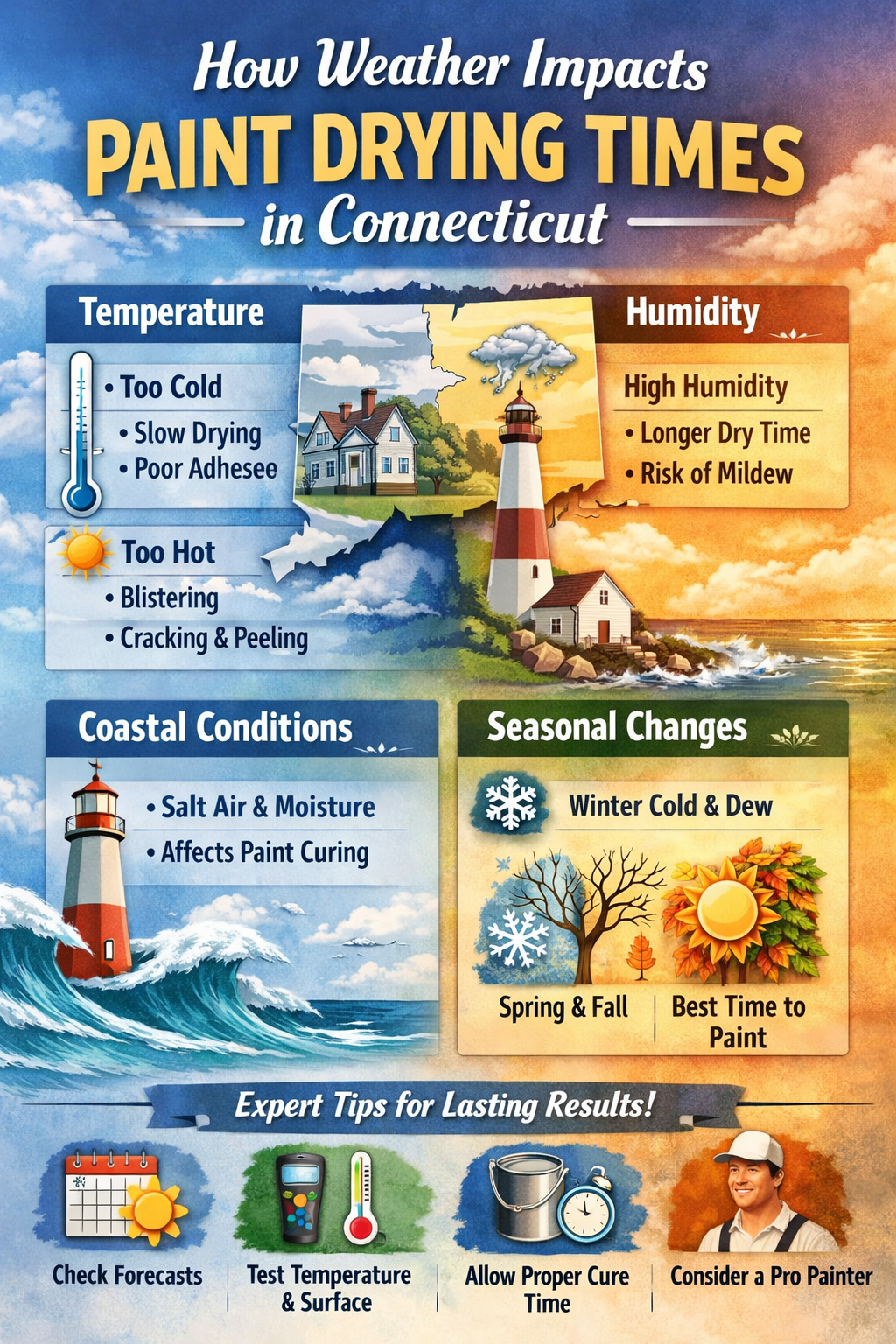
How Temperature Affects Drying
Cold Conditions: When temperatures drop below 50°F, paint drying slows dramatically. The solvent or water in the paint can’t evaporate properly, leading to a tacky finish, weak adhesion, or peeling over time.
Extreme Heat: Excessive heat causes paint to dry too fast on the surface, trapping moisture inside. This imbalance often results in blistering, cracking, or uneven texture once the paint cures.
Balanced Range: The ideal range for most paints lies between 50°F and 85°F, provided humidity remains moderate. This range allows paint to level evenly and bond securely without premature drying.
Low-Temperature Painting: While some modern paints can be applied in cooler conditions, both air and surface temperatures should remain above 35°F–40°F for at least 48 hours to ensure proper curing.
Practical Connecticut Note: In early spring or late fall, Connecticut homeowners should paint during mid-day when temperatures are most stable. Sudden drops in the evening or early morning dew can easily disrupt drying, even on surfaces that feel dry to the touch.
How Humidity and Moisture in Air Influence Drying
High Humidity Slows Evaporation: When air is moist, it resists additional moisture (from the paint) entering it, so evaporation slows. This drags out drying times.
Risks of High Humidity
Blistering / Bubbles if moisture becomes trapped
Mildew / Microbial Growth under the film
Poor Cure causing weaker adhesion
Experts recommend keeping relative humidity between 40% and 70% when painting.
Rain / Residual Moisture: Rain before or soon after painting stalls drying. Even when it stops raining, residual moisture in the air or on surfaces continues to interfere. Ensure that the paint, surface, and air all remain above minimums and that conditions stay stable for 48 hours post-application.
Dry vs Wet Surfaces: A surface that “looks dry” may still retain subsurface moisture, especially wood siding after spring storms. Waiting an extra 24–48 hours of dry conditions is often safer.
Recoat & Cure Timing Depends on Combined Factors
Manufacturer data for Sherwin-Williams’ Duration® exterior paint show that at ~50% RH:
Touch dry in about 1 hour
Recoat window after ~4 hours under ideal conditions
At lower temps (~35–45 °F), recoat windows may stretch to 24–48 hours.
For interior latex paints, Sherwin-Williams notes “dry to touch” within 1–2 hours under optimal conditions, with recoat times around 3–4 hours.
However, real world CT conditions (cool nights, dew, humidity) often require adding buffer time beyond these theoretical windows.
Surface Temperature & Exposure
A wall in shade or over a cooler substrate may remain colder than air temp; this delays drying.
Direct sun can cause surface overheating, making the exterior skin dry too fast, harming the integrity of deeper layers.
In coastal Connecticut, salt spray and moisture can settle on fresh film if wind is blowing, so timing and shielding matter.
Professional Insight From a Connecticut Contractor’s Perspective
As experienced Connecticut painters, we often see jobs with solid intentions go sideways due to misreading the weather. Here’s what we do differently:
Weather Review: Before scheduling, we check multi-day forecasts, dew points, and nighttime lows. If temps may drop under 50 °F or humidity rise, we reschedule.
Product Selection: When needed, we select low-temp or moisture-resistant coatings that can tolerate cooler or wetter conditions. (But these still demand stable windows.)
Dry-time Buffers: We routinely expand manufacturer recoat windows by 20–50% during shoulder seasons or in shaded areas.
Surface Checks: We test the temperature of walls and moisture content before applying.
Interior Environment Control: On cabinet painting jobs, we regulate room temperature, use dehumidifiers, and ventilate so drying proceeds reliably.
Test Patches: On tricky walls (north-facing, shaded, close to ground), we apply a small patch first to observe drying behavior before full coating.
Communication with Clients: We explain timing constraints: e.g. “This week the afternoon window is best, but we’ll need to pause by early evening to avoid dew.”
These steps mitigate the weather risk and preserve finish quality over time.
Local Tip & Seasonal Advice for Connecticut Homeowners
Spring / Early Summer: After spring rains, siding may hold residual moisture even when it looks dry. Wait 24–48 hours of dry, sunny conditions before starting. Early summer days may heat rapidly and humidity may climb, apply in the morning or late afternoon if possible.
Summer: The heat and humidity combination is often the trickiest. On very hot, humid days, paint may overheat or slow in drying. A safer window is early to mid-morning or late afternoon. Avoid midday sun and high humidity peaks.
Early Fall: One of the best windows. Temperatures often remain within the 50–85 °F range, humidity is moderate, and days are relatively dry. Exterior painting here often yields stronger cures before winter.
Late Fall / Winter: Exterior painting is generally ill-advised in CT. Freezing, moisture, and dew make reliable curing unlikely. For Interior painting, it’s possible, but only if:
Room and walls are fully heated (ideally 60 °F+; never under ~50 °F)
Walls may be colder than the air; increasing the thermostat during and 24–36 hours after helps
Humidity is controlled, and ventilation is optimized
Use appropriate paint types per manufacturer guidelines
In winter interior jobs, you may plan them during off-peak months (less foot traffic, fewer conflicts) but that only works when indoor climate control is capable.
When to Hire a Professional Painter
Given all these variables, such as weather, surface, materials, and local conditions, many homeowners find that a professional brings the experience and safeguards needed to get durable, high-quality results. A pro ensures:
Accurate interpretation of forecast data, dew point, and recoat windows
Proper product choice, primers, and additives suited for your project
Meticulous prep, safety, masking, and edge control
Flexibility in scheduling repaints, interior, and exterior
Better final finish, fewer touch-ups, and longer durability
If you’re planning an interior or exterior painting project in Connecticut and want confidence in the outcome, we’d be happy to help. Request a quote or contact us to walk through timing, materials, and conditions.
At J Stokes Contractors, we don’t just paint homes, we protect them. Our team understands Connecticut’s unpredictable climate, from humid coastal towns to cold inland hills. We apply science-backed painting techniques to deliver a flawless, durable finish no matter the season.
Whether you’re freshening up your interior, restoring historic siding, or refinishing your cabinets, we’ll guide you through every step, from timing and prep to product choice and care.
Ready to schedule your next project? Let’s make your home stand out beautifully and built to last through every Connecticut season.